Showing posts with label rags to riches. Show all posts

Thursday, September 13, 2012

The Great Gatsby and All That Jazz


Like The Great GatsbyChicago discusses and showcases the celebrated lifestyles and societal expectations of the Roaring 20's beyond the glitz and glamour of the lavish parties and underground jazz clubs. Both the novel and the film/musical create an atmosphere where corruption is overflowing, drinking is abundant, and sex is an obsession, and yet both capture how magical and unearthly these worlds seem to audiences nowadays. In these worlds, everything is on a grand scale, whether its the glitz of jazz club performers or partygoers or the corruption that's integrated into the management of these clubs or parties. Since The Great Gatsby discusses mostly the upper classes of the 20's and Chicago focuses more on the lower class, average Americans at the time, they can offer a descriptive, broad spectrum of this incredibly fascinating decade when examined together.

Based on a 1926 play of the same name, Chicago is a 1975 Broadway musical turned 2002 movie set in Prohibition-era Chicago. The story centers around two women: Velma Kelley and Roxie Hart. Velma is a Vaudeville performer who gets put in jail for killing her husband and sister after finding out they were having an affair. Roxie is a young woman who cheats on her husband with a supposedly influential man in hope that he will launch her career as a stage performer, but when she finds out he lied to her, she kills him and is sent to jail as well. Both women become celebrities in Chicago for their crimes, but it soon turns into a desperate battle against each other to become more famous. With the help of celebrity lawyer Billy Flynn and Matron "Mama" Morton, their jail matron who believes in reciprocity for her favors, both women get sucked into the twisted, corrupted world of fame in Chicago. When the show first came out, it didn't garner that much popularity because of its dark subtext and cynical criticism of Vaudeville culture, but that is exactly why I love it and why it works so well when used a set of eyes to look deeper into the 1920's.


If we look at the musical song by song, we can see a large variety of observations and criticisms of the society while also getting a sense of the grand theatricality of the decade. The opening song is All That Jazz, where we meet Velma Kelley as she performs at the Annex Club and sings about "living fast and loose" while we also see Roxie getting drunk and committing adultery...and murder. It's very intentional that these two are mirroring each other because the point that John Kander and Fred Ebb, the songwriters, and Bob Fosse, the writer/director, were trying to make is that the 1920's was a time when illegal activity was the most celebrated lifestyle of all. Later on in the story, Billy Flynn is trying to turn Roxie into "the sweetest little jazz killer ever to hit Chicago" by literally puppeteering her to make her say what will sell the most with the news reporters who are looking for some way to turn a crime into a personality. The song that ensues is We Both Reached For The Gun, a very theatrical display intended to reflect the motives of Roxie, Billy, and the reporters. The final song is Nowadays/Hot Honey Rag, where (SPOILER ALERT) Roxie and Velma perform their new act together and sing about how "nothing stays" and the styles are always changing, but "isn't it fun, isn't it...nowadays." That basically sums up the justification for the excessive illegal activity and desperate clawing for fame that is praised so much in this time period: it's fun when it's popular.


Isla Fisher as Myrtle in The Great Gatsby
Now let's look at the parallels between the novel and the musical: Roxie Hart is like Myrtle because both are non-wealthy average Americans who feel stuck in the wrong place and meant to achieve greater things. Both are concerned with gossip and celebrities. Roxie is because she wants to be the gossip, whereas Myrtle is because she wants to show that she can fit in to that upper class culture. Both will do whatever it takes to be a part of this lifestyle that they so long for. Also, Billy Flynn is to Roxie what Tom Buchanan is to Myrtle: a wealthy man of higher status that guides her through the exciting world of the aristocracy and fame. Both of them also have a more wealthy and more famous woman getting in their way as they try to reach the top: Daisy Buchanan for Myrtle and Velma Kelley for Roxie. But the most peculiar parallel between these two characters is that death is their claim to quick fame. Roxie becomes "the sweetest Jazz killer ever to hit Chicago" while Myrtle, when she is killed, gets that fame and recognition she wanted in her life (in the most ironic way possible). But in the end, both of them just had their fifteen minutes of fame and not much else. Roxie can't get an actual stage act, and as people continue talking about Myrtle's death, it seems that the event becomes "less and less real...and Myrtle Wilson's tragic achievement was forgotten" (Fitzgerald 156).

Renee Zellweger as Roxie in Chicago
Possible party guests for Gatsby
Another strong parallel between the two is the attitudes and culture of the people at Gatsby's parties and the general public in Chicago. Both groups emphasize one thing: the flashy, superficial inconstancy of new wealth. Gatsby's parties are, to say the least, extravagant: there are "enough colored lights to make a Christmas tree out of Gatsby's enormous garden" (Fitzgerald 40), full-out orchestras just to show off, and buffets with the most expensive kind of meats anyone can find. However, what's intersting about Gatsby's parties is that they're treated like a business: his Rolls-Royce was described as becoming an "omnibus" and his station wagon was also used to mindlessly transport the guests like a "brisk yellow bug" (Fitzgerald 39). Gatsby didn't have any real relationships with any of his guests since most of them came without even knowing his name. Most of them "came and went like moths" (Fitzgerald 39), women everywhere "never knew each other's names" (Fitzgerald 40), and certain women moved to and from groups, becoming "for a sharp joyous moment the center of the group, and then..glide on" (Fitzgerald 41). While this attitude is common at Gatsby's parties, where the upper class just wants to be entertained for a while, the world that Roxie and Velma live in in Chicago doesn't have the leisure of having a lot of money to spare, so becoming the center of attention seems like what they need to survive this era. However, this culture is very inconstant, as shown when Roxie's trial finishes and, immediately afterwards, another random woman shoots someone and the media runs to her, leaving Roxie behind asking in vain for someone to just take her picture. But in the end, it was all in good fun, because, just like at Gatsby's parties, "oh it's heaven nowadays."


Thursday, May 3, 2012

"Look Twice": Black Star Revises The Bluest Eye


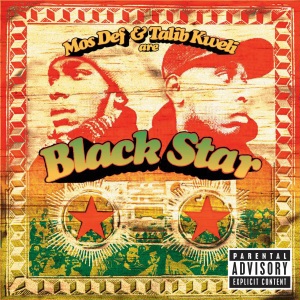
Mos Def and Talib Kweli are Black Star (1998) album cover
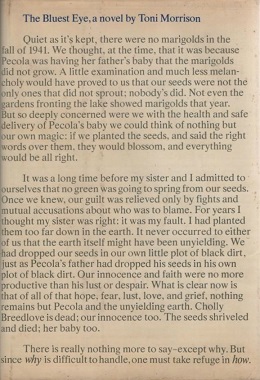
First edition of Toni Morrison's The Bluest Eye (1970)


In the true meaning of "revision," seeing something anew, Talib Kweli and Mos Def of the rap group Black Star, revise the words and the ideas of Toni Morrison's The Bluest Eye in their song "Thieves in the Night" from their self-titled debut album. The song takes its title and its chorus from the closing passage of the novel in which the child narrator, Claudia, reflects on how her classmate Pecola was ostracized unfairly by the black community (and the larger white community) for her alleged "ugliness." Kweli and Def affirm Morrison's argument that, as they put it in the song, "the law of the bluest eye" still governs black experience in America: Anglo-Saxon ideas of beauty, blue eyes, straight, blond hair---are considered the norm. But the rappers also update these "laws" and show how their "jurisdiction" has extended from the segregation-era ideas of racial beauty that the Nobel Prize laureate critiques in her first book. Kweli writes in the liner notes to "Black Star" of reading The Bluest Eye in a high school classroom and how the novel, as he writes, "struck me as one of the truest critiques of our society, and I read that in high school when I was 15 years old. I think it is especially true in the world of hip hop, because we get blinded by these illusions." Within the "hip-hop" context of postindustrial urban African American communities, "the law of the bluest eye" still applies, it guides the actions of the police state in its management of inner-city black bodies.

Kweli at Rawkus Records in NYC, 1999

Mos Def's second verse of "Thieves in the Night" perhaps provides the closest reading of the novel in the song. He begins, "Yo, I'm sure that everbody out listenin agree / That everything you see ain't really how it be." This idea that seeing is not being is critical to The Bluest Eye: Pecola's "ugliness" is never confirmed literally in the text; her lack of beauty is how she is seen by white society, not how she actually looks. Mos Def, though, sees something of the psychology of Pecola's "racial self-loathing," as Morrison calls it in her Afterword, the internalized racism from which Pecola and others in the novel suffer, in contemporary inner-city black male youth:
Most cats in my area be lovin the hysteria
Synthesized surface conceals the interior
America, land of opportunity, mirages and camoflauges
More than usually -- speakin loudly, sayin nothin
Morrison links Pecola's negative self-image to the broader images of normative American identity, family, and home through the juxtaposition of the Breedlove household with the idealized household of Dick and Jane from the primary readers. For Def too, there is a broader national narrative at stake, the very idea of the American dream is little more than a "synthesized surface" that "conceals" a far less hopeful reality. Mos Def seems to argue that it is the worship of materialism, integral to the American dream, that is particularly problematic in black communities when he raps "Gets yours first, them other niggas secondary / That type of illin that be fillin up the cemetery." For Def, the rampant consumerism, perhaps in the rap songs and videos of more mainstream artists, is a form of "mental slavery": "Put you on a yacht, but they don't call it a slaveship." The binary system of racial identification of the Jim Crow era still lingers in the late twentieth century when African American men must chose between being "niggas or Kings." Moreover, the establishment of one's "monarchy" seems contingent on exerting one's power over other blacks, just as Pecola is used as a scapegoat by the larger black community in their establishment of the dichotomy between "niggers" and "colored people" (87).

The American dream family according to the Dick and Jane primers

And fantasy it was, for we were not strong, only aggressive; we were not free, merely licensed; we were not compassionate, we were polite; not good but well behaved, and hid like thieves from life. We substituted good grammar for intellect, we switched habits to simulate maturity; rearranged lies and called it truth, seeing in the new pattern of an old ideas the Revelation and the Word. (206)
The title of Black Star's song seems to argue that blacks are still in some ways hiding their true identities, like "thieves in the night," as a result of the pressures to conform imposed by mainstream American society. By revising the final passage of The Bluest Eye in the chorus to the song, they repeat and develop Morrison's argument that the conformity of assimilation is a kind of social death, in her words, "hiding from life." The idea of being "not strong...only aggressive" bears a specifically interesting relation to the image of the "thug" in modern black life--inner-city gangsters, Def and Kweli seem to argue, are street tough but not truly "strong" in the sense of strength of character. In lyrics added to the final paraphrased passage from The Bluest Eye, Black Star reiterate that young black men may be "chasin' after death," but are not truly "brave." In a clear reference to the style of 1990s gangsta rap, Talib Kweli writes in his first verse to "Thieves in the Night":
Survival tactics means bustin gats to prove you hard
Your firearms are to short for God
Without faith, all of that is illusionary
Raise my son, no vindication of manhood necessary.
The underground rappers are searching for a form of black masculinity not defined by one's "hardness," but by more spiritual qualities like faith and family. Like Morrison does in The Bluest Eye, Black Star attempts to "find beauty in the hideous." Again, for Kweli and Mos Def, the "thug life" is part of the legacy of American chattel slavery with the prison-industrial complex serving as the postmodern plantation.
[M.D.] Not strong
[T.K.] Only aggressive
[M.D.] Not free
[T.K.] We only licensed
[M.D.] Not compassioniate, only polite
[T.K.] Now who the nicest?
[M.D.] Not good but well behaved
[T.K.] Chasin after death
So we can call ourselves brave?
[M.D.] Still livin like mental slaves
[Both] Hidin like thieves in the night from life
Illusions of oasis makin you look twice
[Both] Hidin like thieves in the night from life
Illusions of oasis makin you look twice


Thursday, March 29, 2012

Jay-Z and Jay-Gatz, "Niggas" and Nouveau Riche in Paris and West Egg


This growth of punctilious discrimination as to qualitative excellence in eating, drinking, etc. presently affects not only the manner of life, but also the training and intellectual activity of the gentleman of leisure. He is no longer simply the successful, aggressive male,—the man of strength, resource, and intrepidity. In order to avoid stultification he must also cultivate his tastes, for it now becomes incumbent on him to discriminate with some nicety between the noble and the ignoble in consumable goods. He becomes a connoisseur in creditable viands of various degrees of merit, in manly beverages and trinkets, in seemly apparel and architecture, in weapons, games, dancers, and the narcotics.
- Thorstein Veblen, The Theory of the Leisure Class (1899)

What's Gucci, my nigga? What's Louis, my killa?
What's drugs, my dealer? What's that jacket, Margiela?

- Jay-Z, "Niggas in Paris" (2011)


Thorstein Veblen's concept of "conspicuous consumption" is as easy to apply to the quote nouveau riche unquote of hip hop as it is to fictional West Eggers like the theatrical eponymous MC of Fitzgerald's Great American Novel. Certainly Jay Gatsby has much in common with hip hop impresarios like Jay-Z himself--"The Great Gatsby" surely would have been a rap name if Fitzgerald had not taken it first; it even references the gatling gun popular both among the gangsters of the 1920s and the gangsta rappers of 1990s. More to the point, both Jay-Gatz and Jay-Z came from humble origins, both rose to prominence in part through nefarious means. As newly rich, then, they also share what Thorstein referred to as a "punctilious discrimination as to qualitative excellence." In short, they both know, and demonstrate their knowledge of, the best brands to buy in fashion, cars, and houses (see my reading of Jay-Z's reading of New York architecture). We might, then, view the extravagance of "Niggas in Paris," and Watch the Throne more generally, as hollow yet hopeful in much the same way that Fitzgerald seems to view Gatsby's manifold displays of wealth.


"Ball so hard, this shit weird
We ain’t even s’pose to be here,
Ball so hard, since we here
It’s only right that we be fair."
When Nick and Gatsby are passed on the Long Island Expressway by a limousine full of African Americans, the narrator thinks, "Anything can happen...even Gatsby could happen" (73). Fitzgerald thus aligns Gatsby's mysterious wealth with that of these newly and upwardly
mobile blacks--of course African Americans were making great strides during the Harlem Renaissance just as industrialists were achieving success during the "boom" of the Roaring Twenties. Again, Jay Gatsby and Jay-Z in particular share similar rags to riches American dream narratives. In telling his own success story, Jay-Z aligns himself with the era of the robber barons, naming his brand after the famous industrialist of the early twentieth century. In a way, so does Gatz in his reinvention of himself as Gatsby. Like the lower class Gatz, Jay-Z "ain't spose to be here"; he was born working class and they were born black. There is something that defies the odds in Jay-Z's success: as a young black man in postindustrial America--growing up in the Marcy Projects of Bed-Stuy--the statistics outline a grimmer fate. As he raps, "I'm supposed to be locked up," that is, in prison. Similarly, as a young working class man in industrial America, Gatz should never have made it even to West Egg.


The "spectroscopic gayety" of Gatsby's house parties is matched by the kaleidoscopic (almost epileptic!) bling bling of Jay and Ye in concert in the video for "Niggas in Paris" (49). Models and Gothic architecture are multiplied fantastically through digital effects throughout what is essentially a concert film. While Gatsby's mansion is a "factual imitation of some Hotel de Villein Normandy," it is Notre Dame de Paris that is appropriated by the rappers to evidence their presence in Paris and, more broadly, their "punctilious discrimination" (9). At roughly the 3 minute mark, the Parisian landmark is offered as bridge to Kanye's intro to the "Watch the Throne" theme. The whole Watch the Throne album at once a parallels Gatsby's celebrations of himself through his house parties and offers a social commentary on the meaning of such wealth similar to that in Fitzgerald's novel. While I for one was one of the first haters of the seemingly uncritical pomp of "Watch the Throne," like "East Egg condescending to West Egg," there is a social statement in the fact, as Jay raps in "Otis": "not bad, huh? for some immigrants" (49).
"Ball so hard, got a broke clock, Rolleys that don't tick tock
Audemars that's losing time, hidden behind all these big rocks."


Listening to Jay-Z and Kanye West's "Niggas in Paris," like many of their respective songs, requires a connoisseur's annotations for the multiple allusions to fashion and other luxury industries. We may know Gucci and Louis, at least by name, but Margiela? He's a Belgian fashion designer. Does Beyonce, like Daisy, cry at the beauty of Jay-Z's shirts? We may know about Rollex, but Audemars? Audemars Piguet is a Swiss luxury watchmaker with its origins in the nineteenth century. Jay's particular Audemars is so blinged out with diamonds that he can't even tell the time. We similarly need an encyclopedia to understand the many aristocratic allusions used to describe Gatsby's wealth: the "Marie Antoinette music rooms and Restoration salons" and "Adam study" of his West Egg mansion.


"I’d seen it. Everybody had seen it. It was a rich cream color, bright with nickel, swollen here and there in its monstrous length with triumphant hat-boxes and supper-boxes and tool-boxes, and terraced with a labyrinth of wind-shields that mirrored a dozen suns. Sitting down behind many layers of glass in a sort of green leather conservatory, we started to town."

Gatsby's Rolls-Royce is an emphatic display of his wealth, an attempt to prove his financial prowess and taste to condescending East Eggers. His choice of Rolls is a classic one, though he may have chosen too many options to the point that the car appears garish rather than staid, its "labyrinth of windshields [mirroring] a dozen suns" (68). Something different is going on in Jay-Z and Kanye West's destruction and recreation of DaimlerChrysler AG's Maybach 57 in the video for "Otis." The car cost $350,000 to buy and $150,000 to take apart. They literally dismantle a symbol of old wealth and rebuild it according to their own specs, and then proceed to joy ride with a four models precariously piled in the back seat. As "gentleman of leisure," West and Z prove themselves "connoisseur[s] in creditable viands of various degrees of merit," but they also rewrite the book of etiquette for such conspicuous consumption. With their joyous chopping and then joy riding of the Maybach 57, Z and West flaunt their own misappropriation of old wealth; unlike Gatsby, they are not trying to be anything but themselves. The Maybach 57 was sold at auction with the proceeds benefitting East African drought relief.