Showing posts with label F. Scott Fitzgerald. Show all posts

Sunday, September 16, 2012

Beauty and the Beast and The Great Gatsby


Beauty and the Beast was originally created as one of the Disney Princess movie-musicals, with music by Alan Menken and lyrics by Tim Rice in 1991. It was put on stage in 19, and ran on Broadway for 17 years (making it the 8th longest running show in Broadway history. In both shows, the title song, “Beauty and the Beast”, and “Be Our Guest” are the two most well known numbers in Disney’s history. The show is set in France circa late 1700s, right as the French Revolution is beginning.


The musical focuses on themes of love, societal values, gender roles, revolution, and the American dream. Just as it is said in F. Scott Fitzgerald’s The Great Gatsby, “Whenever you feel like criticizing any one… just remember that all the people in the world haven’t had the advantages you’ve had” (1).  Both works idealize the need to look beyond face value and view someone for whom they are, without comparing them to the values that society has deemed correct. The taboo love stories that each harbor are both endearing and interesting in similar ways: the characters aren’t allowed to be together and end up having to leave each other, though they are still very much in love. Both Belle and Daisy have to choose between true love and being accepted in their proprietary societies.


Beauty and the Beast’s “Cogsworth”, the talking, worrisome clock, has a line where he is showing Belle a hallway styled from the “Late Neo-Classic Baroque Period.” Cogsworth here resembles the part of French society that values the architecture of the past and is a part of creating the Gothic architecture of 16th century France. The Prince’s wealth is old, but his servants aren’t used to the lavish style and are trying to keep alive as much of the castle as they can before it disappears. In the Great Gatsby, the class of New Wealth does the same by styling their houses after Gothic architecture: “it was an factual imitation of the Hotel de Ville in Normandy” (5).  The value of wealth in society is to allude to the wealth of the past, we are “borne back ceaselessly into the past,” to a place that already had establish living standards that can define who is wealthy and who is not.


In the musical, the true villain of the show is Gaston: he is overbearing and assumes that Belle will marry him without question. Before he proposes to Belle he asks of a group of blonde women, “you’re not going to let a little thing like marriage get in the way, now are you?” Gaston wants to marry Belle because she is the most beautiful in the village, as is he, and in this society the aesthetic value tops all others. However, the blonde ‘Silly Singing Girls’ are appalled at the proposal because, as the “inventor’s daughter”, Belle doesn’t come from a wealthy-enough family to be wed to Gaston. In addition, Belle is reprimanded for reading and being a female intellectual.  This idea of social acceptance, or lack thereof, is paralleled by the reaction to Gatsby and Daisy’s relationship, as well as that of Tom and Myrtle. Because Gatsby is New Wealth and Daisy is Old Wealth, Daisy has to choose Tom over Gatsby in an attempt to conform to the Old Wealth homogeneity. Tom would never actually have a relationship with Myrtle because it would be an act of social mobility, which he was taught to look down upon. In all three cases, true love is seen as invaluable when compared to relationships within socioeconomic classes.

Although Beauty and the Beast is set during the French Revolution, the revolution is not shown explicitly in the show as it doesn’t contribute to the story. However, the chord progression in “The Mob Song” mimics that of “One Day More” from Les Miserables, a musical about the French Revolution. Belle is an example of the intellectual set of the French Revolutionists as well as the large gender role reversal that started to occur at that point in time. Gaston and the Silly Singing Girls fight this with a mindset of propriety and manner. The same occurs with Tom’s white supremacist mindset in reaction to the racial revolution of the Roaring 20s. Gaston’s brutishness is a simplified version of Tom’s Anglo-Saxon dominance. In this, Belle’s progressive mindset resembles what would eventually become the American dream, as does her father. His entrepreneurial inventions exemplify how as a member of the working class, he has the dream of making his own money and living life rich: “One day we’ll go live in the castles you read about in your books.” James Gatz had the same desires of living the life of the wealthy.

Tuesday, August 14, 2012

This Land Belongs to Sharon Jones


This land is your land, this land is my land
From California to the New York Island
From the Redwood Forest to the Gulf Stream waters
This land was made for you and me.
It’s probably one of the most popular songs in American history, covered by many great singer-songwriters, but also sung by parents to children and choruses of kids at camp: “This Land is Your Land,” originally composed by the great American folk musician Woody Guthrie in 1944. The song is probably most appreciated today as an uncomplicatedly positive statement about the democracy of the United States, a land that belongs to all people, where anyone with enough hard work and determination can buy that house in the suburbs or that plot of land in the countryside. At the time it was composed, however, Guthrie was actually protesting the increasing privatization of the American landscape. As his guitar reads, “This Machine Kills Fascists”—and he wasn’t talking about the ones in Germany. In many ways, he was standing up for the George Wilson’s of America against the Tom Buchanans, the working class versus the elite. While Tom waltzes freely into George's shop and steals his wife, we cannot imagine George doing the reverse, can we?


Guthrie and his guitar

Sharon Jones and the Dap-Kings

There was a big high wall there that tried to stop me;
Sign was painted, it said private property;
But on the back side it didn't say nothing;
This land was made for you and me.

When the contemporary rhythm and blues singer Sharon Jones sings “This Land is Your Land” with the Dap-Kings, the meaning of the song takes on a whole new connotation. First there is the simple fact that a black woman is singing the lyrics. “This land is my land” just means something different for a white man and a black woman in America. Let’s remember that blacks have been in this country as slaves nearly as long as they have been here free. Even in 1944, could a black woman, or even a black man for that matter, travel freely and safely from "California to New York Island"? To say that such movement is possible, then, from the perspective of an African American woman, is a powerful statement of property ownership and civil rights made by the descendent of slaves. Moreover, the “Private Property” signs of one of Guthrie’s alternative verses included in the Dap-Kings version take on a whole new meaning, reminding the listened of similar signs during the Jim Crow South that specifically limited the movement of African Americans in ways more marked and dangerous than Guthrie’s and other white men ever experienced. 


Then there’s the music, which unlike the lyrics, are significantly altered from the original Guthrie tune. Rather than the simple and singular folk guitar of Guthrie, an individual statement, The Dap-Kings that back Jones are a multi-instrument ensemble, featuring not one but three guitars, drums, and a suite of horns. The song thus becomes a statement about the rights of the group, not just the individual, as if to say, everyone deserves this land, not just the few. Moreover, the musical aesthetic of this version of “This Land is Your Land”—as with most releases off the Daptone label, borrowed from directly for Amy Winehouse's Back to Black—is distinctly Motown, referencing a pivotal moment in black musical entrepreneurship in the 1960s that corresponded with the height of the Civil Rights Era. Motown played a crucial roll in integrating the American music scene and bringing black-owned, -produced and -performed music to white audiences. The sound of the track, then, is the soulful sound of black musical and economic power, emphatically stated in the crisp, clipped horn parts that seem to echo the lyrics of the song similarly laying claim to the “land” of America. Huh!


The original Motown
Ball so hard, this shit weird
We ain’t even s’pose to be here,
Ball so hard, since we here
It’s only right that we be fair. 
- Jay-Z, "Niggaz in Paris" 
When Nick and Gatsby are passed on the Long Island Expressway by a limousine full of African Americans being chauffeured by a white driver, the narrator thinks, "Anything can happen...even Gatsby could happen" (73). It’s a remarkable scene for Nick in part because these African Americans enjoying their freedom represent a major social change over the past few decades in American history. In the first half of the twentieth century, blacks left the South in record numbers and settled in Northern cities like New York, hoping for a better life. The Harlem Renaissance, that flourishing of black artistic culture in the 1920s, was happening at the same time that The Great Gatsby was written and represented a significant shift in American race relations. But given Tom's racist comments at the beginning of the book, though, this success was limited. There was still much poverty and suffering for African American migrants arriving in the North and it would take . Again, while we might imagine Gatsby and Nick going to a Harlem jazz club with Daisy and Jordan, it's hard to imagine the same racial diversity at one of Gatsby's parties. The movement of African Americans was still limited. 


(This scene is such a meaningful and powerful one, I was not surprised to see it featured in the trailers for the new Gatsby movie, along with a sample from Kanye West and Jay-Z’s “Church of the Wild”--it's one of the first shots as the camera zooms in on New York City at the opening of the clip. I'm also not surprised that a track from Watch the Throne was chosen for the 2013 The Great Gatsby. That album's obsession with fame, fortune, and the American dream is shared by many characters in the book. I doubt though that Gatsby would tolerate his Rolls being taken apart the way that Ye and Jay do to the Maybach in the video for "Otis"!)


Sunday, May 13, 2012

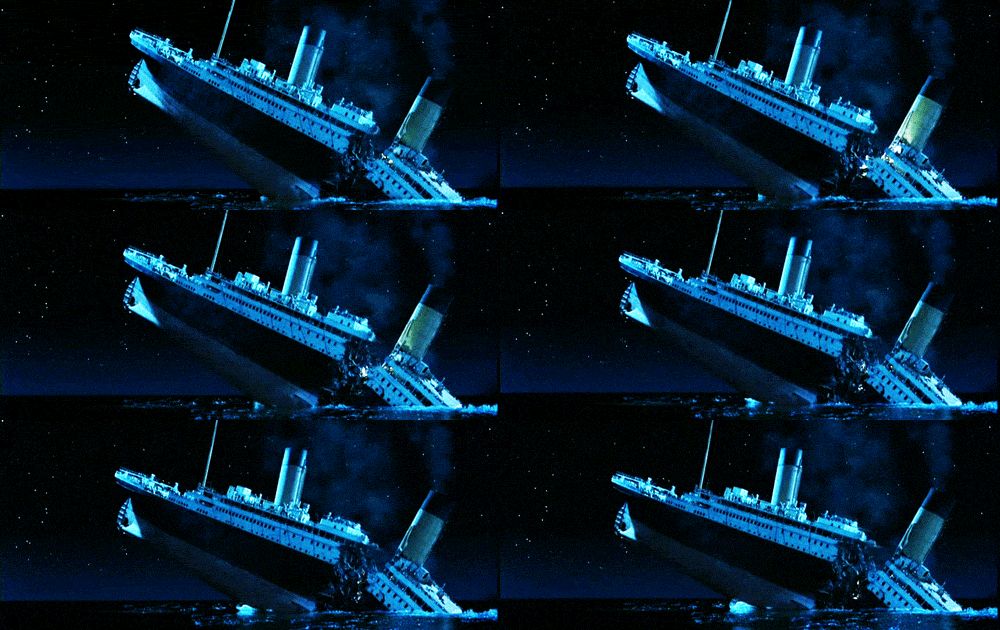
Titanic & The Great Gatsby

In The Great Gatsby, F. Scott Fitzgerald emphasizes the corruptions of the American Dream by conveying the consequences derived from wealth. These consequences include the domination of wealth in the social hierarchy and the lack of social mobility. Similar to The Great Gatsby, the movie Titanic illustrates the dangers that arise from a relationship between an upper class female and a lower class male, in addition to revealing the true, depraved American Dream.


The Great Gatsby and Titanic illustrate the unevenness of power in the social hierarchy because of the upper class’s ascendency. In order to be highest in the social hierarchy, “holocausts” must be made (162). These sacrifices are evident in the Titanic through the discrimination between the first, second, and third class passengers. For example, the ship only had enough lifeboats for 1,178 people, but they were 2,223 passengers total. This unevenness resulted in sacrificing half of the passengers in order to save those in first class. In fact, over 55% of the Titanic survivors were first class passengers. Additionally, the Titanic’s layout positions the first class rooms on the higher floors and the lower classes on the bottom floors. As a result, the lower class floors were the first to flood after the wreck. Additionally, to decrease franticness, workers were commanded to lock the gates and trap the lower classes in their flooded floors. This confinement demonstrates the “holocausts” of lower classes in order to benefit those higher in the social hierarchy.


Titanic and The Great Gatsby both emphasize the ethicality of unattainable social mobility through the two protagonists, Gatsby and Jack. However, the only way to achieve social mobility is through conning. For example, Gatsby “was in the drug business” in order to join the upper class and become “his Platonic conception of himself” (90, 98). Additionally, Jack risked his entire savings in a game of poker for the chance of attaining Titanic boarding passes. Luckily, Jack won the tickets and came aboard the Titanic, which was supposed to sail to America and allow Jack to move up in the social hierarchy because of his insight to the first class passengers.


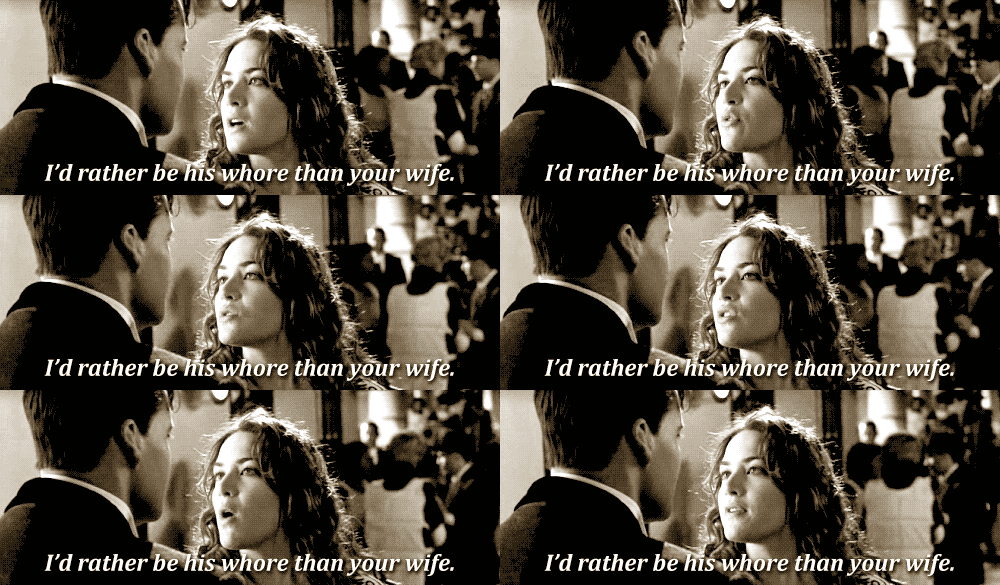
In The Great Gatsby and Titanic the wealthy female character develops a relationship with a poorer man and is then faced to choose between him and a wealthier man. In The Great Gatsby, Daisy fell in love with Gatsby, but he “let her believe that he was a person from much the same stratum as herself” (149). This façade resulted in a fallacious relationship. Additionally, Gatsby compared Daisy with a “grail” and it “excited him, too, that many men had already loved Daisy – it increased her value in his eyes” (149). Viewing Daisy as a price and judging her “value,” Gatsby proves that he only loved Daisy because she was a part of his façade. However, Daisy ultimately chose Tom over Gatsby because he was wealthier. Despite Tom’s affairs, Daisy stayed with him because of their wealthy appearance. In Titanic, Rose was engaged to Cal because her mother pressured Rose to marry him for his money. Despite Jack’s lower class status, Rose chose him over Cal. After the shipwreck, Rose was sitting in one of the last lifeboats, but jumped back onto the ship in order to be with Jack. By returning to the sinking ship, Rose chose Jack over wealth and safety.

Tuesday, April 10, 2012

The Cars of The Great Gatsby


The Yachts

contend in a sea which te land partly encloses
shielding them from the too-heavy blows
of an ungoverned ocean which when it chooses

tortures the biggest hulls, the best man knows
to pit against its beatings, and sinks them pitilessly.
Mothlike in mists, scintillant in the minute

brilliance of cloudless days, with broad bellying sails
they glide to the wind tossing green water
from their sharp prows while over them the crew crawls

ant-like, solicitously grooming them, releasing,
making fast as they turn, lean far over and having
caught the wind again, side by side, head for the mark.

In a well guarded arena of open water surrounded by
lesser and greater crafts which, sycophant, lumbering
and flittering follow them, they appear youthful, rare

as the light of a happy eye, live with the grace
of all that in the mind is fleckless, free and
naturally to be desired. Now the sea whoch holds them

is moody, lapping their glossy sides, as of feeling
for some slightest flaw but fails completely.
Today no race. Then the wind comes again. The yachts

move, jockeying for a start, the signal is set and they
are off. Now the waves strike at them but they are too
well made, the slip through, though they take in canvas.

Arms with hands grasping seek to clutch at the prows
Bodies thrown recklessly in the way are cut aside.
It is a sea of faces about them in agony, in despair

until the horror of the race dawns staggering the mind;
the whole sea become an entanglement of watery bodies
lost to the world bearing what they can not hold. Broken,

beaten, desolate, reaching from the dead to be taken up
they cry out, failing, failing! their cries rising
in waves skill as the skillful yachts pass over.


           For the upper class and those of the working-class, the choice of automobile seems to be a very important one. The proper choice legitimizes a spot in the upper class while a poor one shows a deficiency of taste and culture. Gatsby and Tom both drive expensive cars, but with different purposes. Gatsby's gaudy Rolls-Royce is meant to travel slowly and show off to those who can't even dream of owning one. Tom on the other hand, chooses a quick coupe, reminiscent of William Carlos William's yachts. His car of choice gets him from place to place "quickly and skillfully," and he judges Gatsby for his choices.


"I'd seen it. Everybody had seen it. It was a rich cream color, bright with nickel, swollen here and there in its monstrous length with triumphant hat-boxes and supper-boxes and tool-boxes, and terraced with a labyrinth of wind-shields that mirrored a dozen suns. Sitting down behind many layers of glass in a sort of green leather conservatory, we started to town" (64).

        Gatsby's Rolls-Royce might typically be considered a car for the long established upper class, but in his never ceasing effort to achieve that status, he put so many extras and options onto his car that it looked simply ridiculous. He designed a car to be driven around in and seen by everyone. He wanted something that attracted attention, his first mistake, and it accomplished that goal. As Nick said, everybody had seen the car, he even goes so far as to compare its brightness to a dozens suns, a shining beacon of wealth to show off his fortune. Nick's, and Fitzgerald's, vocabulary in describing the car is even mocking to an extent, exaggerating the wealth inherent in the car with words like "rich," "swollen," "triumphant,""terraced,"and "monstrous." He shows the car as the decadent means of showing off that it is. Nick himself feels the effects of the car once he gets in, he feels as if "behind many layers of glass," like being under a magnifying glass, Nick feels as if he is being scrutinized and oogled at by the public eye. And while Gatsby certainly thinks this is a characteristic of the car to be desired, Nick does not, and Tom certainly would not.


         Tom's choice in automobile on the other hand, is one of old-money taste. In choosing a "silver coupe," Tom chooses a pricey car, but at the same time, not one meant to scream out to all present how much the driver was worth. Much more reminiscent of the "skillful yachts," Tom's car travels swiftly through places like the Valley of Ashes. To someone like Myrtle, the metaphor is complete. When she sees Tom's coupe driving towards her working-class home, its as if she has, "Arms with hands grasping seek to clutch at the prows." The coupe to Myrtle represents a possible means of escape from her barren life, and she jumps at the opportunity to align herself with the driver for as long as possible. Although the coupe represents the essence of mobility crucial to the upper-class,  Myrtle ending up crumpled and lifeless on the street shows that this mobility is something intrinsic to the old-wealth and no one else.

Saturday, April 7, 2012

Jay-Gatz and Tony Montana, The American Dream


This idea of the "American Dream," or the belief that anyone can make it to the top, has truth to it. However, both Gatsby and Tony have their own interpretation of this dream. The idea that America is the land of opportunity encourages many to work as hard as they can so that they might gain material wealth.  There are countless similarities between Jay-Gatz in F. Scott Fitzgerald's "The Great Gatsby" and Tony Montana in the movie "Scar Face." Both start  as poor yet very determined men set on making it to the top no matter what.  Tony came to the U.S. in May of 1980 from Cuba after Fidel Castro opened the harbors in order to let many of his people join their relatives in the U.S.; however, many of the refugees, like Tony, were the "dregs" of Cuba's jails.  Facts scrolled across the screen at the beginning of the movie note that out of the 125,000 refugees, 25,000 had criminal records.  Gatsby was also from humble beginnings.  Gatsby starts off with "a torn green jersey and a pair of canvas pants" (98).  However, despite both men's less than fortunate beginnings, they climb the criminal ladder and achieve their own version of the "American dream."

After achieving success, both men are determined to show off their wealth.  This gaudy extravagance, and in many cases tasteless display of wealth, is a very "new rich" thing to do.  Gatsby has "a man in England who buys [him] clothes" and Tony wears "$800 suits" (92).  However, their display of success does not stop there.  They have overly accessorized cars to the point of being tacky, throw lavish parties and live in large gaudy mansions.  

  Tony's Cadillac                                                        Gatsby's Roll's Royce 


Fitzgerald never says if Gatsby is a bootlegger, but the reader can assume that he is.  The idea that Gatsby is involved in a shady business is referenced throughout the book.  He is always stepping away for important business calls, offers Tom a questionable business opportunity, hangs out with people who are said to have "fixed" the World Series, and says it took only 3 years for him to make the money to build his "hotel de-ville."  Furthermore, the idea that Gatsby is a bootlegger is also brought up by Tom when he says, "A lot of these newly rich people are just big bootleggers" (107).  Tony, like Gatsby, gains his wealth illegally as one of the largest cocaine dealers in Miami.  This criminal acquisition of the "American dream"makes it appear much less legitimate to those around Gatsby and Tony.

Fitzgerald is making a point about the American Dream and its corruptness in his book, "The Great Gatsby," similarly to the way Brian De Palma and Oliver Stone are making points about the American Dream in their movie "Scar Face."  Both pieces illustrate how the authors believe there is a right way and a wrong way of achieving the American Dream and that the "wrong" way or criminal way never pays in the end.  The wealth gained through criminal enterprise does not gain the respect of others and this point is demonstrated when both Gatsby and Tony end up dead in their pools after their corrupt version of the American Dream has crumpled around them.  Fitzgerald, De Palma and Stone make it a point to have Tony's wife leave him and for Daisy to leave Gatsby, as well as leaving their once elegant homes in shambles.  Although Gatsby and Tony believe they have made it to the top and achieved the American Dream, in reality they did nothing and are still nothing.


Thursday, March 29, 2012

Jay-Z and Jay-Gatz, "Niggas" and Nouveau Riche in Paris and West Egg


This growth of punctilious discrimination as to qualitative excellence in eating, drinking, etc. presently affects not only the manner of life, but also the training and intellectual activity of the gentleman of leisure. He is no longer simply the successful, aggressive male,—the man of strength, resource, and intrepidity. In order to avoid stultification he must also cultivate his tastes, for it now becomes incumbent on him to discriminate with some nicety between the noble and the ignoble in consumable goods. He becomes a connoisseur in creditable viands of various degrees of merit, in manly beverages and trinkets, in seemly apparel and architecture, in weapons, games, dancers, and the narcotics.
- Thorstein Veblen, The Theory of the Leisure Class (1899)

What's Gucci, my nigga? What's Louis, my killa?
What's drugs, my dealer? What's that jacket, Margiela?

- Jay-Z, "Niggas in Paris" (2011)


Thorstein Veblen's concept of "conspicuous consumption" is as easy to apply to the quote nouveau riche unquote of hip hop as it is to fictional West Eggers like the theatrical eponymous MC of Fitzgerald's Great American Novel. Certainly Jay Gatsby has much in common with hip hop impresarios like Jay-Z himself--"The Great Gatsby" surely would have been a rap name if Fitzgerald had not taken it first; it even references the gatling gun popular both among the gangsters of the 1920s and the gangsta rappers of 1990s. More to the point, both Jay-Gatz and Jay-Z came from humble origins, both rose to prominence in part through nefarious means. As newly rich, then, they also share what Thorstein referred to as a "punctilious discrimination as to qualitative excellence." In short, they both know, and demonstrate their knowledge of, the best brands to buy in fashion, cars, and houses (see my reading of Jay-Z's reading of New York architecture). We might, then, view the extravagance of "Niggas in Paris," and Watch the Throne more generally, as hollow yet hopeful in much the same way that Fitzgerald seems to view Gatsby's manifold displays of wealth.


"Ball so hard, this shit weird
We ain’t even s’pose to be here,
Ball so hard, since we here
It’s only right that we be fair."
When Nick and Gatsby are passed on the Long Island Expressway by a limousine full of African Americans, the narrator thinks, "Anything can happen...even Gatsby could happen" (73). Fitzgerald thus aligns Gatsby's mysterious wealth with that of these newly and upwardly
mobile blacks--of course African Americans were making great strides during the Harlem Renaissance just as industrialists were achieving success during the "boom" of the Roaring Twenties. Again, Jay Gatsby and Jay-Z in particular share similar rags to riches American dream narratives. In telling his own success story, Jay-Z aligns himself with the era of the robber barons, naming his brand after the famous industrialist of the early twentieth century. In a way, so does Gatz in his reinvention of himself as Gatsby. Like the lower class Gatz, Jay-Z "ain't spose to be here"; he was born working class and they were born black. There is something that defies the odds in Jay-Z's success: as a young black man in postindustrial America--growing up in the Marcy Projects of Bed-Stuy--the statistics outline a grimmer fate. As he raps, "I'm supposed to be locked up," that is, in prison. Similarly, as a young working class man in industrial America, Gatz should never have made it even to West Egg.


The "spectroscopic gayety" of Gatsby's house parties is matched by the kaleidoscopic (almost epileptic!) bling bling of Jay and Ye in concert in the video for "Niggas in Paris" (49). Models and Gothic architecture are multiplied fantastically through digital effects throughout what is essentially a concert film. While Gatsby's mansion is a "factual imitation of some Hotel de Villein Normandy," it is Notre Dame de Paris that is appropriated by the rappers to evidence their presence in Paris and, more broadly, their "punctilious discrimination" (9). At roughly the 3 minute mark, the Parisian landmark is offered as bridge to Kanye's intro to the "Watch the Throne" theme. The whole Watch the Throne album at once a parallels Gatsby's celebrations of himself through his house parties and offers a social commentary on the meaning of such wealth similar to that in Fitzgerald's novel. While I for one was one of the first haters of the seemingly uncritical pomp of "Watch the Throne," like "East Egg condescending to West Egg," there is a social statement in the fact, as Jay raps in "Otis": "not bad, huh? for some immigrants" (49).
"Ball so hard, got a broke clock, Rolleys that don't tick tock
Audemars that's losing time, hidden behind all these big rocks."


Listening to Jay-Z and Kanye West's "Niggas in Paris," like many of their respective songs, requires a connoisseur's annotations for the multiple allusions to fashion and other luxury industries. We may know Gucci and Louis, at least by name, but Margiela? He's a Belgian fashion designer. Does Beyonce, like Daisy, cry at the beauty of Jay-Z's shirts? We may know about Rollex, but Audemars? Audemars Piguet is a Swiss luxury watchmaker with its origins in the nineteenth century. Jay's particular Audemars is so blinged out with diamonds that he can't even tell the time. We similarly need an encyclopedia to understand the many aristocratic allusions used to describe Gatsby's wealth: the "Marie Antoinette music rooms and Restoration salons" and "Adam study" of his West Egg mansion.


"I’d seen it. Everybody had seen it. It was a rich cream color, bright with nickel, swollen here and there in its monstrous length with triumphant hat-boxes and supper-boxes and tool-boxes, and terraced with a labyrinth of wind-shields that mirrored a dozen suns. Sitting down behind many layers of glass in a sort of green leather conservatory, we started to town."

Gatsby's Rolls-Royce is an emphatic display of his wealth, an attempt to prove his financial prowess and taste to condescending East Eggers. His choice of Rolls is a classic one, though he may have chosen too many options to the point that the car appears garish rather than staid, its "labyrinth of windshields [mirroring] a dozen suns" (68). Something different is going on in Jay-Z and Kanye West's destruction and recreation of DaimlerChrysler AG's Maybach 57 in the video for "Otis." The car cost $350,000 to buy and $150,000 to take apart. They literally dismantle a symbol of old wealth and rebuild it according to their own specs, and then proceed to joy ride with a four models precariously piled in the back seat. As "gentleman of leisure," West and Z prove themselves "connoisseur[s] in creditable viands of various degrees of merit," but they also rewrite the book of etiquette for such conspicuous consumption. With their joyous chopping and then joy riding of the Maybach 57, Z and West flaunt their own misappropriation of old wealth; unlike Gatsby, they are not trying to be anything but themselves. The Maybach 57 was sold at auction with the proceeds benefitting East African drought relief.