Showing posts with label Passing. Show all posts

Sunday, May 13, 2012

Titanic & The Great Gatsby

In The Great Gatsby, F. Scott Fitzgerald emphasizes the corruptions of the American Dream by conveying the consequences derived from wealth. These consequences include the domination of wealth in the social hierarchy and the lack of social mobility. Similar to The Great Gatsby, the movie Titanic illustrates the dangers that arise from a relationship between an upper class female and a lower class male, in addition to revealing the true, depraved American Dream.


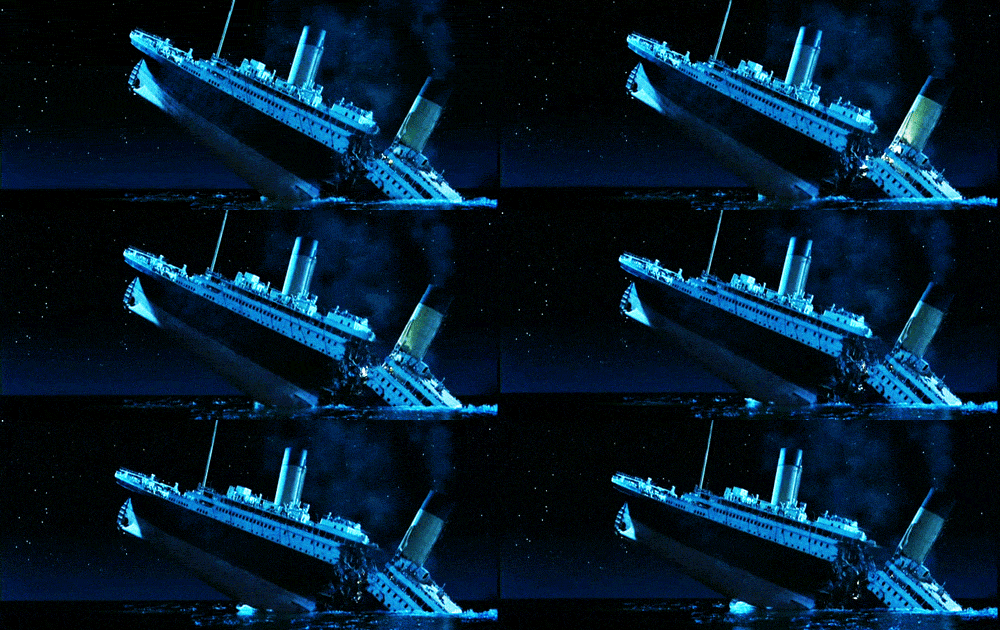
The Great Gatsby and Titanic illustrate the unevenness of power in the social hierarchy because of the upper class’s ascendency. In order to be highest in the social hierarchy, “holocausts” must be made (162). These sacrifices are evident in the Titanic through the discrimination between the first, second, and third class passengers. For example, the ship only had enough lifeboats for 1,178 people, but they were 2,223 passengers total. This unevenness resulted in sacrificing half of the passengers in order to save those in first class. In fact, over 55% of the Titanic survivors were first class passengers. Additionally, the Titanic’s layout positions the first class rooms on the higher floors and the lower classes on the bottom floors. As a result, the lower class floors were the first to flood after the wreck. Additionally, to decrease franticness, workers were commanded to lock the gates and trap the lower classes in their flooded floors. This confinement demonstrates the “holocausts” of lower classes in order to benefit those higher in the social hierarchy.

Titanic and The Great Gatsby both emphasize the ethicality of unattainable social mobility through the two protagonists, Gatsby and Jack. However, the only way to achieve social mobility is through conning. For example, Gatsby “was in the drug business” in order to join the upper class and become “his Platonic conception of himself” (90, 98). Additionally, Jack risked his entire savings in a game of poker for the chance of attaining Titanic boarding passes. Luckily, Jack won the tickets and came aboard the Titanic, which was supposed to sail to America and allow Jack to move up in the social hierarchy because of his insight to the first class passengers.


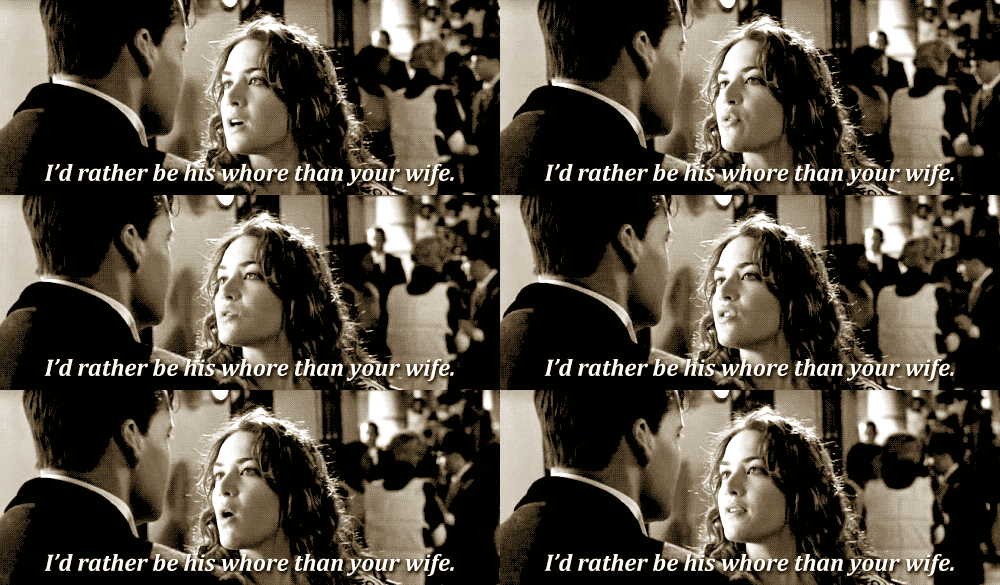
In The Great Gatsby and Titanic the wealthy female character develops a relationship with a poorer man and is then faced to choose between him and a wealthier man. In The Great Gatsby, Daisy fell in love with Gatsby, but he “let her believe that he was a person from much the same stratum as herself” (149). This façade resulted in a fallacious relationship. Additionally, Gatsby compared Daisy with a “grail” and it “excited him, too, that many men had already loved Daisy – it increased her value in his eyes” (149). Viewing Daisy as a price and judging her “value,” Gatsby proves that he only loved Daisy because she was a part of his façade. However, Daisy ultimately chose Tom over Gatsby because he was wealthier. Despite Tom’s affairs, Daisy stayed with him because of their wealthy appearance. In Titanic, Rose was engaged to Cal because her mother pressured Rose to marry him for his money. Despite Jack’s lower class status, Rose chose him over Cal. After the shipwreck, Rose was sitting in one of the last lifeboats, but jumped back onto the ship in order to be with Jack. By returning to the sinking ship, Rose chose Jack over wealth and safety.

Tuesday, April 10, 2012

The Cars of The Great Gatsby


The Yachts

contend in a sea which te land partly encloses
shielding them from the too-heavy blows
of an ungoverned ocean which when it chooses

tortures the biggest hulls, the best man knows
to pit against its beatings, and sinks them pitilessly.
Mothlike in mists, scintillant in the minute

brilliance of cloudless days, with broad bellying sails
they glide to the wind tossing green water
from their sharp prows while over them the crew crawls

ant-like, solicitously grooming them, releasing,
making fast as they turn, lean far over and having
caught the wind again, side by side, head for the mark.

In a well guarded arena of open water surrounded by
lesser and greater crafts which, sycophant, lumbering
and flittering follow them, they appear youthful, rare

as the light of a happy eye, live with the grace
of all that in the mind is fleckless, free and
naturally to be desired. Now the sea whoch holds them

is moody, lapping their glossy sides, as of feeling
for some slightest flaw but fails completely.
Today no race. Then the wind comes again. The yachts

move, jockeying for a start, the signal is set and they
are off. Now the waves strike at them but they are too
well made, the slip through, though they take in canvas.

Arms with hands grasping seek to clutch at the prows
Bodies thrown recklessly in the way are cut aside.
It is a sea of faces about them in agony, in despair

until the horror of the race dawns staggering the mind;
the whole sea become an entanglement of watery bodies
lost to the world bearing what they can not hold. Broken,

beaten, desolate, reaching from the dead to be taken up
they cry out, failing, failing! their cries rising
in waves skill as the skillful yachts pass over.


           For the upper class and those of the working-class, the choice of automobile seems to be a very important one. The proper choice legitimizes a spot in the upper class while a poor one shows a deficiency of taste and culture. Gatsby and Tom both drive expensive cars, but with different purposes. Gatsby's gaudy Rolls-Royce is meant to travel slowly and show off to those who can't even dream of owning one. Tom on the other hand, chooses a quick coupe, reminiscent of William Carlos William's yachts. His car of choice gets him from place to place "quickly and skillfully," and he judges Gatsby for his choices.


"I'd seen it. Everybody had seen it. It was a rich cream color, bright with nickel, swollen here and there in its monstrous length with triumphant hat-boxes and supper-boxes and tool-boxes, and terraced with a labyrinth of wind-shields that mirrored a dozen suns. Sitting down behind many layers of glass in a sort of green leather conservatory, we started to town" (64).

        Gatsby's Rolls-Royce might typically be considered a car for the long established upper class, but in his never ceasing effort to achieve that status, he put so many extras and options onto his car that it looked simply ridiculous. He designed a car to be driven around in and seen by everyone. He wanted something that attracted attention, his first mistake, and it accomplished that goal. As Nick said, everybody had seen the car, he even goes so far as to compare its brightness to a dozens suns, a shining beacon of wealth to show off his fortune. Nick's, and Fitzgerald's, vocabulary in describing the car is even mocking to an extent, exaggerating the wealth inherent in the car with words like "rich," "swollen," "triumphant,""terraced,"and "monstrous." He shows the car as the decadent means of showing off that it is. Nick himself feels the effects of the car once he gets in, he feels as if "behind many layers of glass," like being under a magnifying glass, Nick feels as if he is being scrutinized and oogled at by the public eye. And while Gatsby certainly thinks this is a characteristic of the car to be desired, Nick does not, and Tom certainly would not.


         Tom's choice in automobile on the other hand, is one of old-money taste. In choosing a "silver coupe," Tom chooses a pricey car, but at the same time, not one meant to scream out to all present how much the driver was worth. Much more reminiscent of the "skillful yachts," Tom's car travels swiftly through places like the Valley of Ashes. To someone like Myrtle, the metaphor is complete. When she sees Tom's coupe driving towards her working-class home, its as if she has, "Arms with hands grasping seek to clutch at the prows." The coupe to Myrtle represents a possible means of escape from her barren life, and she jumps at the opportunity to align herself with the driver for as long as possible. Although the coupe represents the essence of mobility crucial to the upper-class,  Myrtle ending up crumpled and lifeless on the street shows that this mobility is something intrinsic to the old-wealth and no one else.