Toni Morrison
plays around the idea of a double consciousness is brought up multiple times in
“The Bluest Eye”. The ideas of racial self-loathing that the character deal
with are put into the heads of the characters in the novel because of their
double consciousness. As humans we
are programmed to care about how other perceive us , but in the cases presented
in the novel they are taken to another extreme. A man by the man of W.E.B Du Bois was a famous author he became
famous for his protest against racial prejudice and discrimination also for this idea in a paragraph in a book called "The Souls of Black Folk" in chapter one “Of Our Spiritual Strivings”. The paragraph reads:
“After the Egyptian and Indian, the Greek and Roman, the Teuton
and Mongolian, the Negro is a sort of seventh son, born with a veil, and gifted
with second-sight in this American world,—a world which yields him no true
self-consciousness, but only lets him see himself through the revelation of the
other world. It is a peculiar sensation, this double-consciousness, this sense
of always looking at one’s self through the eyes of others, of measuring one’s
soul by the tape of a world that looks on in amused contempt and pity. One ever
feels his two-ness,—an American, a Negro; two souls, two thoughts, two
unreconciled strivings; two warring ideals in one dark body, whose dogged
strength alone keeps it from being torn asunder.”
Du bois calls
direct attention to the fact that we are only as powerful or have as much worth
as society grants us.
In
the bluest eye there is an ongoing theme of self-loathing. Claudia wants to be
as “pretty” as the white girls, Pecola is desperate for blue eyes and blonde
hair, and Geraldine tries her hardest t separate her family from the “niggers”
by keeping her home immaculate. They all are unable to accept their race without
hating themselves. In the most extreme case there is Pecola. On page 47 the
narrator says” she would see only what there was to see: the eyes o other
people. Pecola has become invisible to herself and others”. She has been brain
washed by the common culture that she is not worthy to be looked at. She only
cares about what other see, the way other sees her.
Pecola
ultimately becomes obsessed with the idea of society; in the end she convinces
herself that she has blue eyes. The last chapter of the book is a conversation
with Pecola and an imaginary friend. Pecola is so obsessed with the idea of how
others perceives, she has to create an imaginary friend to comfort her, She
cannot learn to accept herself for who she is so her mind creates an outsider
that will. This directly proves Du Bois’s theory about the need to be accepted
my others. Pecola cooping mechanism is to create an imaginary friend that will
support her insanity,. This is extremely tragic event because the only way that
Pecola is able to be happy is to create a fake double-consciousness and become
mentally insane, to the point were society is even less accepting of her this
way than the in her normal state.
Whether a person considers herself to be beautiful or hideous, an individual's expectation and desire to meet appearance standards is emotionally and psychologically consuming. Toni Morrison's The Bluest Eye illustrates the feelings of self-hatred derived from social acceptances and external attitudes towards African Americans through Pecola Breedlove's character, while Dove has created a beauty campaign in attempt to destroy any sense of personal abhorrence and establish a new idea of beauty in the minds of self-conscious individuals. Before the novel even begins, Morrison introduces the romanticized image of beauty in the Dick and Jane reader, continued before each paragraph, claiming that blonde, light skinned, blue-eyed little girls were considered beautiful beyond any opposition. This fascination with a specific look was mimicked in media, advertisements, and consumer goods that surrounded the characters, shaping the opinions of African American girls and women that eventually would see themselves as ugly. Pecola Breedlove suffocates under this predetermined standard for so long that she begins to long for blue eyes, as if that is requirement to being beautiful. Her mind is warped by her obsession of sorts, and her thoughts explode: "Pretty eyes. Pretty blue eyes. Big blue pretty eyes...They run with their blue eyes. Four blue eyes. Four pretty blue eyes" (46).
Formatted like the Dick and Jane books, Pecola's thoughts focus solely on her desire to be white, to be pretty, to be like Jane. If she could not completely disappear from existence, Pecola focused all of her conscious effort on shedding her ugliness or, in her mind, attaining blue eyes.
Female perceptions in the twenty-first century share the same pressures and yearnings in terms of objectified appearance.Under Dove research it was calculated that "only 4% of women around the world consider themselves beautiful," while over three fourths of women believe beauty lies within everyone but simply cannot locate their own (Dove). Unlike many commercial products that alter and mask appearances, Dove is not based on transforming the female physical image, yet building the self-esteem that makes each girl or woman comfortable in her own skin.
For their advertisements Dove doesn't look for the skinniest girl, or the tallest, or the one whose picture would appear in the mind of any girl imagining someone beautiful, but one that is real; a image that consumers and witnesses can relate to; one that is normal.
Pecola Breedlove is the ultimate victim to the four percent statistic, as she finds nothing beautiful about herself, yet discovers more and more imperfections, as do her Black friends. The girls: Pecola, Freida, and Claudia, are blatantly called ugly by their lighter-skinned classmate Maureen. Hurt and convinced of the insult's truth, the trio "walked quickly at first, and then slower, pausing every now and then to fasten garters, tie shoelaces, scratch, or examine old scars. [They] were sinking under the wisdom, accuracy, and relevance of Maureen's last words" (74). The obsessive attention to detail found in the minds of Morrison's characters is beyond that of any comfortable, confident child. The girls fasten, tie, scratch, and examine as means of pointing out each visible flaw which others point out as overriding any aspect of beauty.
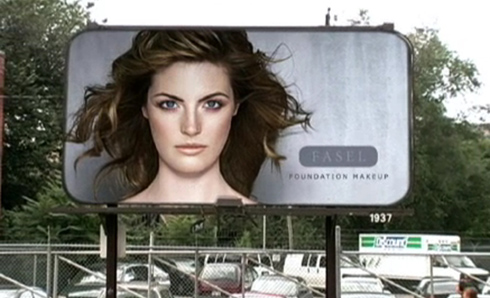
It is the Dove Corporation and its campaign for real beauty that illustrates that no one resembles Jane, or in current terms, no one resembles the face staring at you from a magazine, billboard, or catalog. In the evolution video, Dove's most prominent campaign tool, a team pulls a simple girl- pieced with average blemishes and face structure- and constructs her to fit a particular image to be placed on a public billboard. The resulting picture, after the model is made over, photographed, photo-shopped, and printed captures the eyes and consumes the thoughts of numerous minds, like those of the two girls captured admiring the final picture at the end of the film.
The two images above are perceived by thousands as the same face and image, yet, behind the scenes, the first is real while the the second is completely computerized to perfection. Dove's mission is to publicize that no person fits the mold of beautiful that implants the minds of girls and women who desire such attributes for themselves. It sets out to revive senses of self-worth in those that only see ugliness, and therefore such a program could have been one to help save Pecola from self-destruction.