Showing posts with label Social Mobility. Show all posts

Sunday, September 16, 2012

Jay-Z and Gatsby's American Dream


           “My President is Black” by Young Jeezy and Jay-Z portrays the American Dream in the sense that people are making money and moving from a lower social class to a higher one. The “American Dream” is defined as enduring life’s hardships and overcoming social and economic set-backs in order to be a “somebody”. As well, a big part of the “American Dream” is not only becoming wealthy but also having more than enough money to live comfortably. Jay-Z raps about people who start out as having a social and economic disadvantage but who reach the top of the “social ladder” because of their perseverance and determination to make life better for themselves.  In The Great Gatsby by Scott Fitzgerald, Gatsby is a parallel to the people Jay-Z raps about because he too started out being poor and had to work his way up to being wealthy. Gatsby was disciplined and worked hard so that he could achieve the “American Dream”; his hard work resulted in him having a surplus amount of money to spend on flashy, unnecessary items just like Jay-Z.  Materialism is inevitable when one attains the American Dreams of wealth so items like cars and “bling” become necessary to achieve the ideal status.  To those who came from nothing, it is empowering and satisfying to be able to buy pompous and flashy objects. A diverse amount of colors with these flashy objects is also important because it represents their joy and pride in being wealthy.


             In “My President is Black”, Jay-Z talks about the progress of the African American race and says “Rosa Park sat so Martin Luther could walk, Martin Luther walked so Barack Obama could run, Barack Obama ran so all the children could fly.” Not only does this quote emphasize the progressions of a race but it also symbolizes the defeat of the social standard and people moving from one extreme of the social class to the other. “Rosa Parks sat” refers to the 1950s when an African American woman refused to follow the social norm of sitting in the back of the bus.  
Rosa Parks sitting in front of a white
Although this is line is directed toward the African American rights movement, it is also significant because it shows that Rosa Parks didn’t have a car, an object that is a necessity to the American Dream, which stresses her position in the lowest social class. Like Rosa Parks, Gatsby started at the bottom of the “social ladder”, having little possessions to his name; yet Gatsby refused to accept his fate of being poor in the same way that Rosa Parks refused to accept her fate as being an African American in the back of the bus.  On the other hand, Barack Obama is now president of the United States and at the opposite end of the social spectrum, which couldn’t have been achieved without the perseverance and determination of other African American civil right advocates such as Martin Luther King. Gatsby too earned his wealth and status through determination and hard work, which can be seen from his strict schedule and plan for success that he had written in his book. The progress of the African American race and Gatsby’s economic success are both examples of the American Dream because both exceeded the social standard and have made a more than enough money to live comfortably.
Martin Luther King Jr.
Barack Obama in the White House


              Cars are critical in the idea of the American Dream because they symbolize wealth and freedom.  Jay-Z mentions his cars multiple times throughout the song by saying, “my president is black my maybach too…my money dark green and my porsche is light gray,” because he is proud to own items that represent such important aspects in life. Also, “Maybach” and “Porsche” are some of the most expensive and high-end car brands, which accentuate his wealth. For Jay-Z, whose ancestors were most likely slaves, having a car of his own is worth bragging about because the car represents his wealth and gives him freedom by enabling him to move about however he pleases. In The Great Gatsby, Fitzgerald draws attention to Gatsby’s car for the same reasons that Jay-Z draws attention to his own car. Gatsby’s extravagant car is another way for him to boast about his economic success. Cars are also a luxury to those who can afford them because walking or taking a bus is never necessary, which was Rosa Parks’ and Gatsby’s means of transportation before they succeeded. A car is the perfect representation of the American Dream because it gives freedom to the individual who owns it and it acts as a measurement of one’s wealth.
Porsche 
Maybach


           Throughout “My President is Black”, Jay-Z uses color to describe his material objects because they demonstrate the joy that comes with being wealthy.  Jay-Z describes his maybach as “black”, his diamonds as “blue”, his money as “dark green” and his Porsche as “light gray”. Color adds an exciting element to Jay-Z’s wealth and makes the rich seem effortlessly fabulous. Gatsby’s life is also frequently described as being colorful, and the most directly related example is his “yellow” car. Color enriches the wealthy’s life style and represents the joy of having money.   
So many colors!
                 
The Great Gatsby and “My President is Black” both take the same approach to defining the American Dream.  Both describe this "Dream" as people having the opportunity to make something of themselves, having enough money to own nice items, and being able to move around carelessly from one social group to another having achieved social mobility. In “My President is Black”, Jay-Z discusses the success of the African American race as it moved from being seen as an inferior race of servants in the U.S. to governing the white house. Similar to Jay-Z, Nick, in The Great Gatsby, acknowledges the same progress that is being made by African Americans and comments,

“A limousine passed us, driven by a white chauffeur, in which sat three modish negroes, two bucks and a girl. I laughed as the yolks of their eyeballs rolled toward us in haughty rivalry. ‘Anything can happen now that we’ve slid over this bridge,’ I thought; ‘Anything at all.’”(Fitzgerald 69)


Social mobility at its finest
Although Nick acts supercilious towards the “negroes” in the limousine, he is amazed that “anything can happen” in New York now that African Americans have moved up the “social ladder”. This scene is significant because it epitomizes the progress of African Americans, who went from being slaves to being driven around by someone who a hundred year earlier would have previously been seen as their master.  Jay-Z also references 'flying' in his song and says, “Barack Obama ran so all the children could fly, ima spread my wings, you can meet me in the sky.” Flight in this lyric represents both opportunity and social mobility. Jay-Z’s wealth gives him complete social mobility by allowing him to exceed social standards and reach the “sky.” In The Great Gatsby, the same idea is exhibited when Nick describes two wealthy girls, Daisy and Jordan, by saying, “They were both in white, and their dresses were rippling and fluttering as if they had just been blown back in after a short flight around the house.” (Fitzgerald 8) The girls are able to carelessly “fly” around their house because their money relieves any economic burden that they would feel if they were not wealthy.  Their “white” dresses even compare them to angels, which places them above all other social classes. Daisy and Jordan’s money allows them to be free of stress and dominate the social world. Both Jay-Z and Fitzgerald ‘s works illustrate the American Dream through the social progression of two people and the comfortable living that both have achieved.

Tuesday, August 14, 2012

This Land Belongs to Sharon Jones


This land is your land, this land is my land
From California to the New York Island
From the Redwood Forest to the Gulf Stream waters
This land was made for you and me.
It’s probably one of the most popular songs in American history, covered by many great singer-songwriters, but also sung by parents to children and choruses of kids at camp: “This Land is Your Land,” originally composed by the great American folk musician Woody Guthrie in 1944. The song is probably most appreciated today as an uncomplicatedly positive statement about the democracy of the United States, a land that belongs to all people, where anyone with enough hard work and determination can buy that house in the suburbs or that plot of land in the countryside. At the time it was composed, however, Guthrie was actually protesting the increasing privatization of the American landscape. As his guitar reads, “This Machine Kills Fascists”—and he wasn’t talking about the ones in Germany. In many ways, he was standing up for the George Wilson’s of America against the Tom Buchanans, the working class versus the elite. While Tom waltzes freely into George's shop and steals his wife, we cannot imagine George doing the reverse, can we?


Guthrie and his guitar

Sharon Jones and the Dap-Kings

There was a big high wall there that tried to stop me;
Sign was painted, it said private property;
But on the back side it didn't say nothing;
This land was made for you and me.

When the contemporary rhythm and blues singer Sharon Jones sings “This Land is Your Land” with the Dap-Kings, the meaning of the song takes on a whole new connotation. First there is the simple fact that a black woman is singing the lyrics. “This land is my land” just means something different for a white man and a black woman in America. Let’s remember that blacks have been in this country as slaves nearly as long as they have been here free. Even in 1944, could a black woman, or even a black man for that matter, travel freely and safely from "California to New York Island"? To say that such movement is possible, then, from the perspective of an African American woman, is a powerful statement of property ownership and civil rights made by the descendent of slaves. Moreover, the “Private Property” signs of one of Guthrie’s alternative verses included in the Dap-Kings version take on a whole new meaning, reminding the listened of similar signs during the Jim Crow South that specifically limited the movement of African Americans in ways more marked and dangerous than Guthrie’s and other white men ever experienced. 


Then there’s the music, which unlike the lyrics, are significantly altered from the original Guthrie tune. Rather than the simple and singular folk guitar of Guthrie, an individual statement, The Dap-Kings that back Jones are a multi-instrument ensemble, featuring not one but three guitars, drums, and a suite of horns. The song thus becomes a statement about the rights of the group, not just the individual, as if to say, everyone deserves this land, not just the few. Moreover, the musical aesthetic of this version of “This Land is Your Land”—as with most releases off the Daptone label, borrowed from directly for Amy Winehouse's Back to Black—is distinctly Motown, referencing a pivotal moment in black musical entrepreneurship in the 1960s that corresponded with the height of the Civil Rights Era. Motown played a crucial roll in integrating the American music scene and bringing black-owned, -produced and -performed music to white audiences. The sound of the track, then, is the soulful sound of black musical and economic power, emphatically stated in the crisp, clipped horn parts that seem to echo the lyrics of the song similarly laying claim to the “land” of America. Huh!


The original Motown
Ball so hard, this shit weird
We ain’t even s’pose to be here,
Ball so hard, since we here
It’s only right that we be fair. 
- Jay-Z, "Niggaz in Paris" 
When Nick and Gatsby are passed on the Long Island Expressway by a limousine full of African Americans being chauffeured by a white driver, the narrator thinks, "Anything can happen...even Gatsby could happen" (73). It’s a remarkable scene for Nick in part because these African Americans enjoying their freedom represent a major social change over the past few decades in American history. In the first half of the twentieth century, blacks left the South in record numbers and settled in Northern cities like New York, hoping for a better life. The Harlem Renaissance, that flourishing of black artistic culture in the 1920s, was happening at the same time that The Great Gatsby was written and represented a significant shift in American race relations. But given Tom's racist comments at the beginning of the book, though, this success was limited. There was still much poverty and suffering for African American migrants arriving in the North and it would take . Again, while we might imagine Gatsby and Nick going to a Harlem jazz club with Daisy and Jordan, it's hard to imagine the same racial diversity at one of Gatsby's parties. The movement of African Americans was still limited. 


(This scene is such a meaningful and powerful one, I was not surprised to see it featured in the trailers for the new Gatsby movie, along with a sample from Kanye West and Jay-Z’s “Church of the Wild”--it's one of the first shots as the camera zooms in on New York City at the opening of the clip. I'm also not surprised that a track from Watch the Throne was chosen for the 2013 The Great Gatsby. That album's obsession with fame, fortune, and the American dream is shared by many characters in the book. I doubt though that Gatsby would tolerate his Rolls being taken apart the way that Ye and Jay do to the Maybach in the video for "Otis"!)


Sunday, May 13, 2012

Titanic & The Great Gatsby

In The Great Gatsby, F. Scott Fitzgerald emphasizes the corruptions of the American Dream by conveying the consequences derived from wealth. These consequences include the domination of wealth in the social hierarchy and the lack of social mobility. Similar to The Great Gatsby, the movie Titanic illustrates the dangers that arise from a relationship between an upper class female and a lower class male, in addition to revealing the true, depraved American Dream.


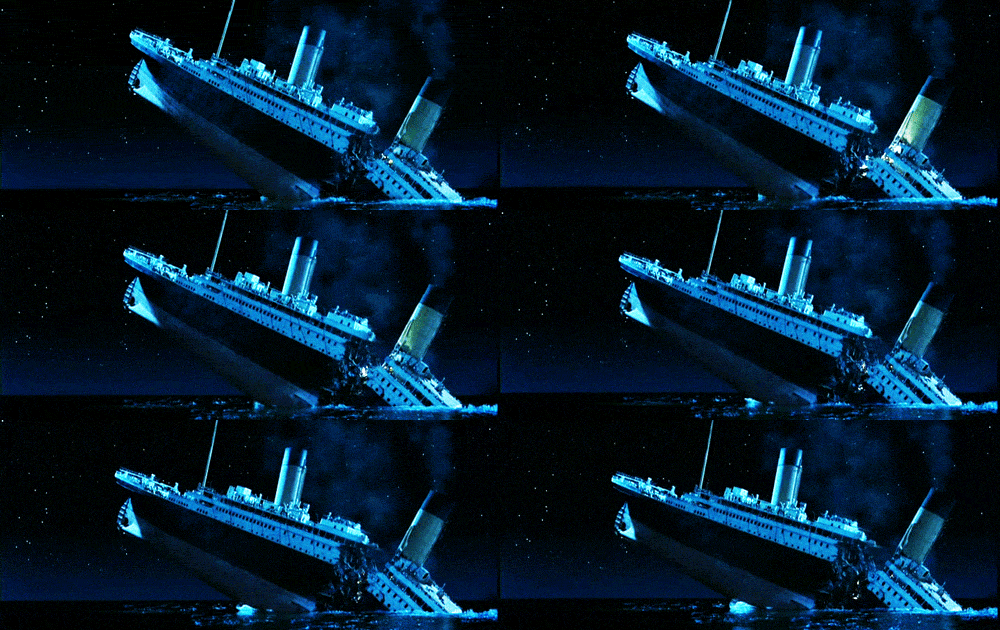
The Great Gatsby and Titanic illustrate the unevenness of power in the social hierarchy because of the upper class’s ascendency. In order to be highest in the social hierarchy, “holocausts” must be made (162). These sacrifices are evident in the Titanic through the discrimination between the first, second, and third class passengers. For example, the ship only had enough lifeboats for 1,178 people, but they were 2,223 passengers total. This unevenness resulted in sacrificing half of the passengers in order to save those in first class. In fact, over 55% of the Titanic survivors were first class passengers. Additionally, the Titanic’s layout positions the first class rooms on the higher floors and the lower classes on the bottom floors. As a result, the lower class floors were the first to flood after the wreck. Additionally, to decrease franticness, workers were commanded to lock the gates and trap the lower classes in their flooded floors. This confinement demonstrates the “holocausts” of lower classes in order to benefit those higher in the social hierarchy.


Titanic and The Great Gatsby both emphasize the ethicality of unattainable social mobility through the two protagonists, Gatsby and Jack. However, the only way to achieve social mobility is through conning. For example, Gatsby “was in the drug business” in order to join the upper class and become “his Platonic conception of himself” (90, 98). Additionally, Jack risked his entire savings in a game of poker for the chance of attaining Titanic boarding passes. Luckily, Jack won the tickets and came aboard the Titanic, which was supposed to sail to America and allow Jack to move up in the social hierarchy because of his insight to the first class passengers.


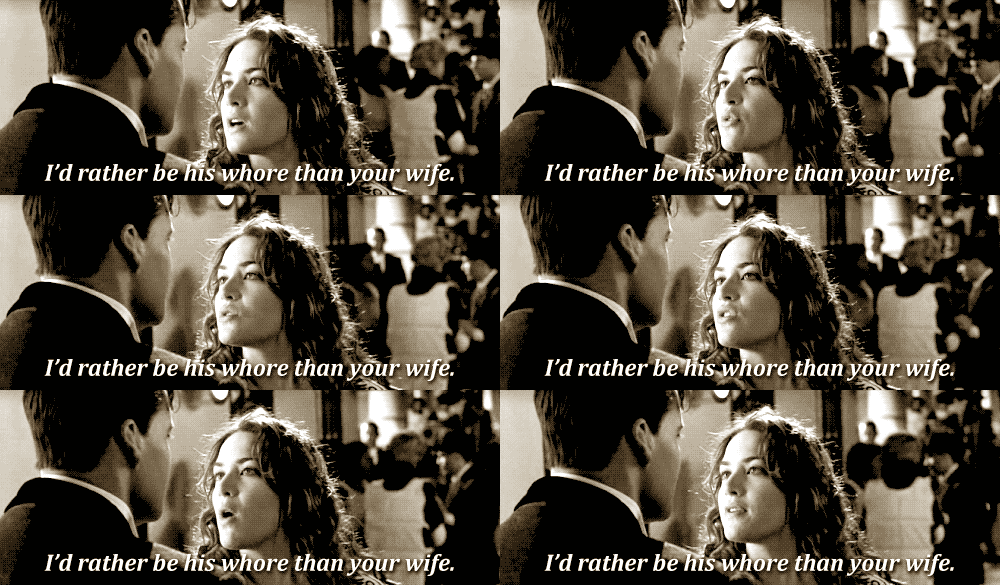
In The Great Gatsby and Titanic the wealthy female character develops a relationship with a poorer man and is then faced to choose between him and a wealthier man. In The Great Gatsby, Daisy fell in love with Gatsby, but he “let her believe that he was a person from much the same stratum as herself” (149). This façade resulted in a fallacious relationship. Additionally, Gatsby compared Daisy with a “grail” and it “excited him, too, that many men had already loved Daisy – it increased her value in his eyes” (149). Viewing Daisy as a price and judging her “value,” Gatsby proves that he only loved Daisy because she was a part of his façade. However, Daisy ultimately chose Tom over Gatsby because he was wealthier. Despite Tom’s affairs, Daisy stayed with him because of their wealthy appearance. In Titanic, Rose was engaged to Cal because her mother pressured Rose to marry him for his money. Despite Jack’s lower class status, Rose chose him over Cal. After the shipwreck, Rose was sitting in one of the last lifeboats, but jumped back onto the ship in order to be with Jack. By returning to the sinking ship, Rose chose Jack over wealth and safety.